Quantum-Classical Computing
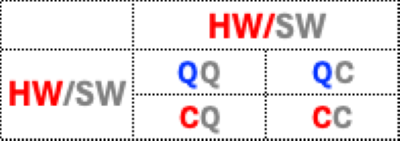
Classical computers have been used for wide variety of tasks, from word processing to controlling complex systems, while quantum computers, on the other hand, are good at specialized computational workloads where their classical counterparts are less efficient. Our benchmark analysis intends to capture complex distributions with high fidelity, making them a powerful but energy-hungry alternative to traditional simulators. As in the case of computational complexity, we can establish limits on the performance of quantum learning compared with the classical flavor. Quantum Machine Learning (QML) may not be more efficient than classical learning—at least from an information- theoretic perspective, up to polynomial factors, although this needs to be quantified. On the other hand, there are apparent computational advantages for quantum algorithms: specific classes of algorithms have been estimated to be polynomial-time exact-learnable from quantum membership queries, but they are not polynomial-time learnable from classical algorithms. Thus, quantum machine learning can take logarithmic time in both the number of vectors and their dimension. This is an exponential speedup over classical algorithms, but at the price of having both quantum input and quantum output. Our systematic research intends to analyze Quantum x Classical mapped on to Hardware and Software as illustrated in the figure below.
While there are similarities between classical and quantum methods, there are also important differences. Because quantum algorithms are more efficient on quantum computers, noise in these computers can be a major issue. This includes hardware noise such as decoherence as well as statistical noise (that is, shot noise) that arises from measurements (quantum-classical interface dependent) on quantum states. Both noise sources add to complexity in training. Moreover, nonlinear operations (for example, neural activation functions) that are natural in classical ML require more careful design of QML models due to the linearity of quantum transformations. For the field of QML, the immediate goal for the near future is demonstrating quantum advantage, that is, outperforming classical methods, in a data science application. Achieving this goal will require keeping an open mind about which applications will benefit most from QML (for example, it may be an application that is quantum mechanical). In CeecS, our focus will be on understanding how QML methods scale to large problem sizes will also be required, including analysis so that energy estimates can be compared for co-design across classical-quantum regimes. In addition, the combination of classical and quantum devices with algorithms will be studied for energy efficiency.


