About
The effort is to establish a first-of-its-kind center on energy efficient computing addressing energy and material efficiency driven by systematic measurements and characterization of computer systems. With focus on energy needs for Computing, we believe that the Center for Energy Efficient Computing Systems will enable growth of compute-centric Artificial Intelligence for the US and the community. Our intent is to design and develop the science of measuring and evaluating AI models for computing. As energy of computing is driven by the entire stack from transistors to algorithms, this effort is built on the following four pillars and additional cross-cut for education and workforce development:
- Analysis, testing, and publishing, energy efficiency in all layers of computing, including establishing benchmarks, validating them spanning different hardware and software;
- Prototypes of co-designed and heterogeneous systems that will provide insights 100X (on existing software base) energy efficiency in five years;
- New forms of computing to address energy efficiency by research on fundamental abstractions of information processing using lessons from nature. Examples include Brain-inspired computing (beyond neuromorphic); Quantum-inspired computing (based on principles including cryo-engineering); Edge-centric computing (for sensing including metrology); Reservoir computing (for analogue systems) etc.;
- Energy and material estimates of processing, assembling, and packaging of new technologies in Microelectronics to address specific aspects of supply chain problems.
- Develop courses & Workforce development for Energy Efficient Computing for Stanford and wider educational outreach. The intent is to illustrate the potential scientific and technological breakthroughs needed in computing beyond the geometrical-based scaling of Moore’s law for a new paradigm on Design for Energy Efficiency. In addition, this will include several internships and projects for students wot work from supply chain to technical analysis and research associated with energy and material efficiency. A new course is being offered in the spring of 2026 on Reframing Computing from Energy Perspective: From Biological Systems to Artificial Intelligence:
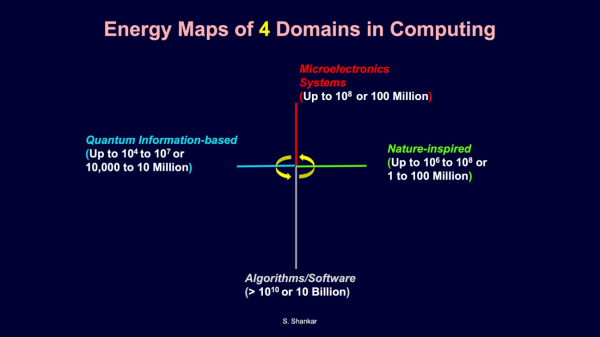
The CeecS Laboratory based at SLAC and Stanford will address the gaps to answer the question on How energy efficient can the computing systems compared to the thermodynamic limit? This is illustrated in the following figure which indicates the energy efficiency possible compared to the thermodynamic limit (normalized to 300K), formulated for the EES2 Project from the Department of Energy’s AMMTO office. The overall area of computing can be divided into four domains, moving clockwise. The numbers relate to the ratio of energy estimated for a specific computing attribute to the energy of thermodynamic limit: i) Microelectronics Systems, embodying the hardware/architectures in von Neumann based computing systems; ii) Nature-inspired systems, in which computing is built on principles of nature such as Neuromorphic Computing; iii) Algorithms/Software: As the algorithms determine the compute operations, they form a distinct domain. Examples include Transformer models based on Deep neural Networks; iv) Quantum-Information systems are based on processing information based on systems which follow quantum mechanical laws.
CeecS is currently funded by Department of Energy’s Office of Science contract DE-AC02-76SF00515 with SLAC through an Annual Operating Plan agreement from the Office of Energy Efficiency and Renewable Energy’s Advanced Manufacturing and Materials Technology Office and SLAC Program Development Funds.


